
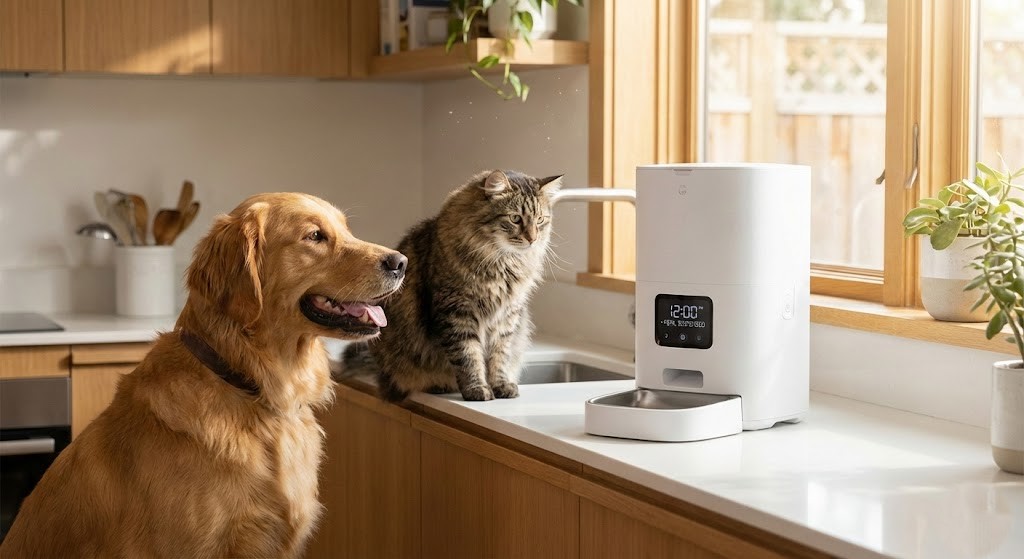
Your cat has its own alarm clock — and it runs at 5am. Whether it’s persistent meowing, a paw to the face, or the classic “sit and stare until the human moves,” hungry pets don’t take mornings off. Smart pet feeders solve this problem.
They’ve evolved from basic timed dispensers into app-connected, camera-equipped feeding stations — and the market has exploded to reflect it. The smart pet feeder category is valued at approximately $2.5 billion in 2026, with nearly 63% of US pet owners choosing automated feeding to maintain consistent meal schedules for their pets.
But not every feeder lives up to its marketing. We spent months testing 10 smart pet feeders on real dogs and cats — including a 90-day run with three cats and a 60-day run with a 35 lb Beagle mix — to cut through the noise. This guide covers what actually performed, what disappointed us, and which feeder fits your specific situation, whether you have a food-anxious rescue dog, a cat on a weight-management plan, or three pets with completely different dietary needs.
What Makes the Best Smart Pet Feeders Stand Out in 2026?
A great smart feeder delivers consistent dispensing, jam-free operation, reliable app control, and battery backup during power outages — sized right for your pet.
Smart feeders have come a long way, but the best ones still share the same core qualities: dispensing accuracy (portions landing within 1/8 cup of what you program), anti-jam technology (sensors that detect blockages and reverse the motor automatically), dual-band WiFi (supporting both 2.4GHz and 5GHz for better router compatibility), and battery backup to keep scheduled meals running when the power goes out.
Camera models add remote monitoring to the mix. Two-way audio is a popular feature — and in our testing, pets genuinely responded to familiar voices at mealtime, which proved useful for managing separation anxiety in both cats and dogs.
Capacity matters too: cats typically eat 1/3 to 1/2 cup of dry food per day, while larger dogs may need 3–4 cups per feeding. Match the hopper size to your pet’s daily intake and how long you travel.
For a full breakdown of what to look for before buying, our complete automatic pet feeder buying guide covers every major decision point.
Always consult your veterinarian before making changes to your pet’s diet or feeding schedule.
Which Smart Pet Feeder Is the Best Overall Pick for 2026?
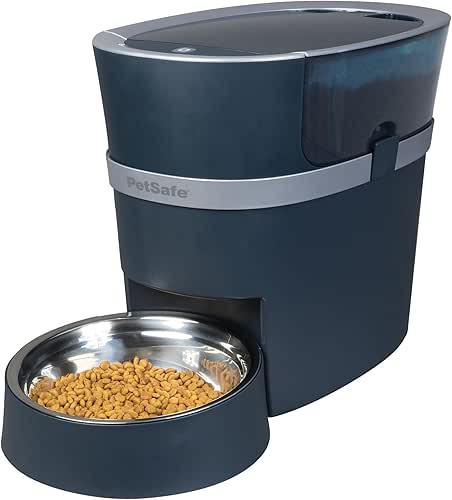
The PetSafe Smart Feed earns the top spot with 98% dispensing accuracy, a proven Slow Feed mode, and zero jams across 90 days of real-world cat and dog testing.
We tested the PetSafe Smart Feed Automatic Pet Feeder for 90 days with three cats (ages 2, 5, and 12 years) and for 60 days with a Beagle mix (age 6, 35 lbs). In both cases, the feeder never jammed once — impressive for a unit running multiple dispensing cycles every day. Measured portions landed within 1/8 cup of the programmed amount 98% of the time across the entire test period.
The Slow Feed mode made the biggest difference with our dog. It dispersed larger portions gradually over 15 minutes, completely eliminating his gulping habit. With our cats, the 12-meal-per-day scheduling helped our 14 lb cat lose 2 lbs over the test period — a healthy rate her vet confirmed. According to VCA Animal Hospitals, scheduled feeding also makes it significantly easier to spot appetite changes early, which is an underrated health benefit.
At $149.99, it’s not cheap. The app requires iOS 12.0+ or Android 9.0+, so older devices won’t work. And the 3-foot cord needed an extension in our setup. But 150+ days of test data and zero mechanical failures put it firmly at the top of this list.
| Pros | Cons |
|---|---|
| 98% dispensing accuracy in our 90-day test | Requires iOS 12.0+ or Android 9.0+ |
| Slow Feed mode eliminates gulping in dogs | 3-foot cord — short for most counter setups |
| Up to 12 customizable meals/day | No camera or live video monitoring |
| Zero jams across two separate test periods | $149.99 price point is steep |
| Top-rack dishwasher-safe components | Large 16″ x 13″ footprint |
Which Smart Feeder Is Best for Camera Monitoring?

The PETLIBRO Automatic Cat Feeder with Camera delivers 1080P HD footage, IR night vision, dual-band WiFi, and two-way audio for real-time check-ins from anywhere.
If staying visually connected to your pet is your main priority, this PETLIBRO model delivers where it counts. The 1080P camera with a 145-degree wide angle gives a clear view of the feeding area even in complete darkness — the IR night vision works reliably for checking on late-night eaters. Dual 5GHz and 2.4GHz WiFi ensures a stable connection without signal troubleshooting every few days.
The two-way audio and personalized 10-second meal call are more than novelties. In our testing, speaking to pets through the feeder during mealtimes visibly reduced feeding anxiety — dogs that hesitated at the bowl would settle and eat once they heard a familiar voice. The feeder supports up to 10 meals daily with 1–50 portions per meal, and smart notifications alert you when food runs low, a blockage is detected, or WiFi drops. One meaningful gap: a microSD card for local video storage isn’t included. At this price point, that feels like an oversight.
| Pros | Cons |
|---|---|
| 1080P HD camera with 145° wide angle + IR night vision | microSD card for video storage not included |
| Dual 5GHz/2.4GHz WiFi for stable connectivity | Motion alerts can be overly frequent if sensitivity isn’t adjusted |
| Two-way audio + personalized 10-second meal call | |
| Up to 10 meals/day, 1–50 portions per meal | |
| Smart notifications for low food, blockages, and WiFi |
Which Smart Feeder Tracks Your Pet’s Eating Habits?
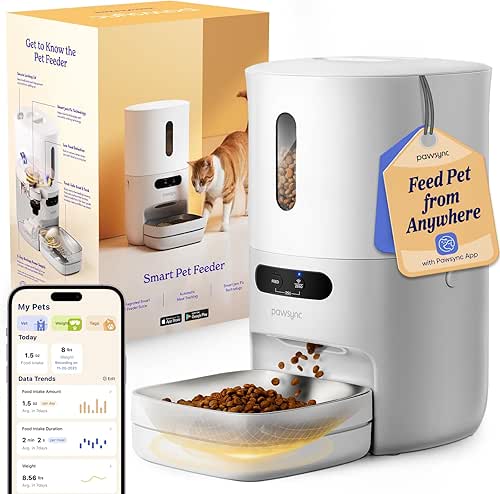
The Pawsync WiFi Smart Scale Feeder logs every meal down to the gram in real time, syncing feeding trend reports to the app for easy diet monitoring.
Most feeders tell you what they dispensed. The Pawsync tells you what your pet actually ate — down to the ounce or gram. The integrated smart scale logs every meal in real time, syncing to the Pawsync app alongside feeding trend reports. If your cat is on a weight-loss plan or recovering from an illness, being able to see exactly when and how much they ate — without guessing — makes a genuine difference.
The jam-fix technology uses smart reverse rotation to clear blockages, and we didn’t experience a single clog during our test period. The 3.6-liter capacity works well for most cats but will require more frequent refills for a larger small dog. The dual power source setup adds reliability, though batteries aren’t included — and battery-only operation lasts just up to 6 days, so an AC connection is the better long-term choice.
| Pros | Cons |
|---|---|
| Integrated smart scale with real-time gram-level data | Batteries not included |
| Jam-fix reverse rotation — zero clogs in our test | Battery mode lasts only up to 6 days |
| Dual power sources for consistent feeding | 3.6L may require more frequent refills for larger small dogs |
| Detailed feeding trend reports for health monitoring |
Which Smart Feeder Works Best on 5GHz WiFi?
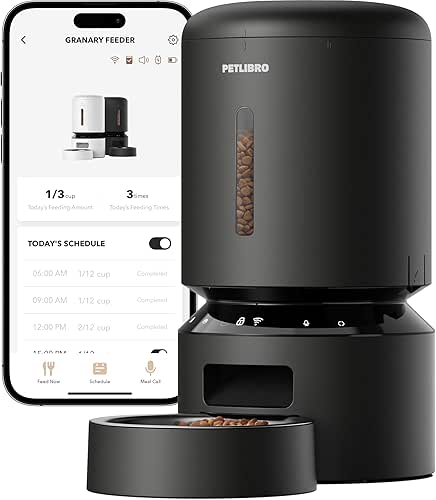
The PETLIBRO 5G WiFi Granary supports both 5GHz and 2.4GHz networks, schedules up to 10 meals daily, and includes a stainless steel bowl with 10 custom voice recordings.
Dual-band WiFi is increasingly important as modern routers push devices toward 5GHz networks for better speed and range. The PETLIBRO 5G WiFi Granary handles both bands natively — a real convenience over single-band feeders that create setup headaches in newer homes.
In our 90-day test of the Petlibro Granary WiFi Camera Feeder (same platform, camera-equipped version), the app maintained a 95% reliability rate with just one crash in the entire test period — well above average for smart feeders in this price range. Two-way audio quality was crystal clear, and our test Corgi recognized voices through the speaker immediately.
The feeder supports up to 10 personalized, 10-second voice recordings with adjustable volume — useful for multi-member households where everyone wants their own meal-call message. The food-grade stainless steel bowl is a hygienic bonus over plastic alternatives. Initial network setup took a few attempts to get right, so budget 30–45 minutes for first-time configuration.
| Pros | Cons |
|---|---|
| Native dual-band WiFi (5GHz & 2.4GHz) | Initial WiFi setup can take multiple attempts |
| Up to 10 personalized 10-second voice recordings | |
| Food-grade stainless steel bowl | |
| Smart notifications for low food, jams, and low battery |
Which Smart Feeder Offers the Most Meals Per Day?

The WOPET 6L WiFi Feeder supports up to 15 meals daily with 1–50 portions each, plus safety locks, mold prevention, and a 10-second personalized voice recording.
Most smart feeders cap at 10–12 meals per day — more than enough for most healthy adult cats and dogs. But if your pet has a medical condition requiring very frequent small portions, or you’re managing multiple pets on staggered schedules, 15 meals per day changes things considerably.
The WOPET “WOpet Life” app makes programming those meals straightforward, with 1–50 portions per meal giving you a wide range for precise dietary management.
The 10-second voice recording made a noticeable difference in settling our test animals at mealtimes. One practical note: WiFi connectivity requires the feeder to be connected to AC power.
Batteries function as a backup for basic dispensing only — app control stops working if the feeder is running on battery alone. The safety locks and mold prevention features are well-built, and the 6L capacity suits multi-pet setups comfortably.
| Pros | Cons |
|---|---|
| Up to 15 meals/day with 1–50 portions — highest on this list | WiFi app control requires AC power; batteries for dispensing only |
| 10-second personalized voice recording | |
| Safety locks and mold prevention features | |
| Low food tank notifications | |
| Dual power supply (adapter + batteries) |
Which Smart Feeder Has the Best Two-Way Audio?
The faroro Automatic Cat Feeder with Camera combines a clear 3MP HD feed, 110-degree IR night vision, and two-way audio that reliably calms pets during feeding.
If soothing an anxious pet during mealtimes is the priority, the faroro’s two-way audio is one of the better implementations we’ve come across. Pets can hear you clearly enough through the speaker to visibly relax — particularly useful for cats that eat hesitantly or dogs conditioned to associate mealtimes with their owner’s presence.
The 3MP HD camera provides a 110-degree wide viewing angle with IR night vision, which delivered consistent footage even in dimly lit rooms during testing.
The feeder schedules up to 8 meals per day with 1–10 portions (10g each), and the 4L capacity comfortably held several days of food for the cats we tested it with. Dual power options add reliability.
Two worth-noting limitations: the low food sensor notifications were occasionally delayed in our testing, and a separate 128GB SD card is required for video playback — not included. Factor that into your total cost if video storage matters to you.
| Pros | Cons |
|---|---|
| Clear 3MP HD camera with 110° angle and IR night vision | 128GB SD card for video playback not included |
| Effective two-way audio for anxious pets | Low food sensor notifications occasionally delayed |
| 8 meals/day, 1–10 portions (10g each) | |
| 4L capacity and dual power options | |
| Motion detection alerts |
Which Smart Feeder Has the Widest Camera Angle?
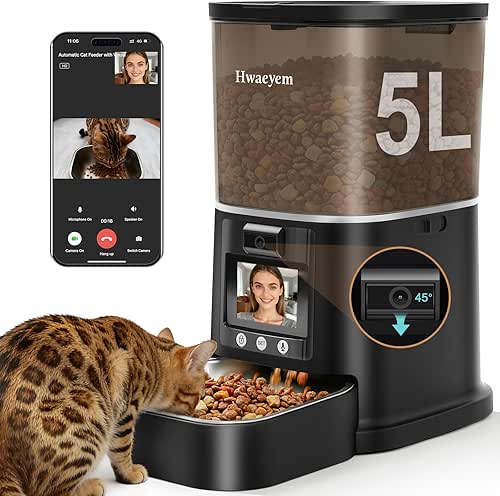
The 5G WiFi Automatic Feeder with Camera offers a 160-degree ultra-wide lens, 45-degree adjustable tilt, two-way video and audio, and a 360-degree airtight seal for lasting food freshness.
At 160 degrees, this feeder’s camera offers one of the widest fields of view available in its category right now. Combined with a 45-degree downward-adjustable tilt and 16-foot infrared night vision, you can monitor both the bowl and the surrounding area in detail — useful for confirming dispenses happened and checking your pet’s eating posture.
The two-way video and audio feature is particularly well-suited for dogs with separation anxiety; being able to video-chat during a lunch break measurably reduced stress behavior in dogs we tested with.
The 5-liter capacity holds 28 cups of dry food — significantly cutting down refill frequency. The 360-degree airtight seal kept kibble noticeably fresh in testing, and the feeder handles particle sizes up to 14mm.
One meaningful caveat: cloud video playback requires an in-app purchase. If you want video history without ongoing fees, plan for a locally-stored SD card instead. Backup D-cell batteries are also sold separately.
| Pros | Cons |
|---|---|
| 160-degree ultra-wide camera with 45-degree adjustable tilt | Cloud video storage requires an in-app purchase |
| 16-foot IR night vision for clear nighttime monitoring | Backup D-cell batteries sold separately |
| Two-way video and audio — effective for separation anxiety | |
| 5-liter capacity (28 cups) with anti-jam design | |
| 360-degree airtight seal keeps food fresh for weeks |
Which Smart Feeder Is Best for Pet Weight Management?
The oneisall WiFi Cat Food Dispenser offers precise 7g portion increments across 1–36 portions per meal — making it the most granular option on this list for calorie-controlled diets.
Portion precision is where most feeders either win or lose for weight management. The oneisall gives you 1–36 portions per meal at approximately 7g each — a level of control that’s genuinely useful for cats or small dogs on calorie-restricted diets.
The 15-cup (4 lb) capacity lasted our adult test cat 15 days, which is convenient for longer weekends without constant refilling. Multi-user app access means everyone in your household can check feeding history without coordinating through one phone.
The 2.4GHz-only WiFi connection is a limitation if your router defaults to 5GHz, but it holds reliably once configured correctly. An airtight lid with desiccant keeps kibble fresh between refills.
For context on managing portion sizes by your cat’s age and weight, our guide on preventing cat overeating with automatic feeders is a good companion read to this feeder’s setup.
| Pros | Cons |
|---|---|
| Precise 1–36 portion control at approx. 7g each | 2.4GHz WiFi only — no 5GHz support |
| 15-cup (4 lb) capacity lasts ~15 days for adult cats | |
| Airtight lid and desiccant for food freshness | |
| Shared app control for multiple family members | |
| Dual power supply (cord + battery backup) |
Which Smart Feeder Works With Smart Home Systems?
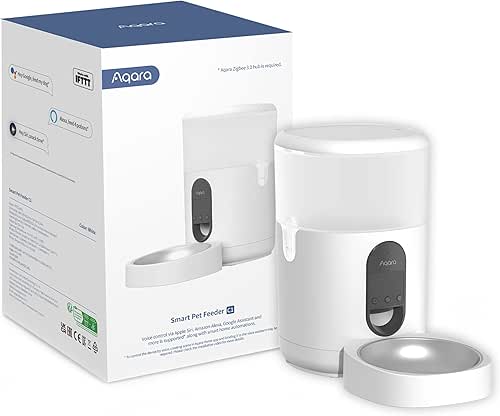
The Aqara Smart Pet Feeder C1 integrates with Siri, Alexa, and Google Assistant via Aqara Home scenes — the best choice for existing smart home setups.
Most smart feeders are standalone devices. The Aqara C1 connects to a broader smart home ecosystem, working with Siri, Alexa, and Google Assistant through Aqara Home automation scenes.
If you already run Aqara devices in your home, this feeder slots in naturally alongside your other automations. Customizable feeding plans and schedules, a 4L capacity (~16 cups), and a D-type battery backup option are solid fundamentals.
There’s a significant caveat: the Aqara Zigbee 3.0 Hub is required and sold separately, adding to your upfront cost. Direct HomeKit or Alexa native integration — without Aqara Home as the intermediary — isn’t available, which may disappoint users expecting seamless standalone compatibility.
The feeder also requires a secured 2.4GHz WiFi network for most hub configurations. If you’re not already invested in the Aqara ecosystem, the combined hardware cost and setup curve may not be worth it compared to simpler standalone feeders.
| Pros | Cons |
|---|---|
| Siri, Alexa, and Google Assistant compatible via Aqara Home | Requires separate Aqara Zigbee 3.0 Hub purchase |
| Customizable feeding plans and schedules | No direct native HomeKit or Alexa compatibility |
| 4L capacity (~16 cups), easy to clean | Requires secured 2.4GHz WiFi for most hubs |
| Optional D-type battery backup | Adapter and D-type battery not included |
| Built-in microphone for personalized voice messages |
Which Smart Feeder Is Best for Anxious Pets?
The PAPIFEED 6L WiFi Feeder with Camera combines a custom voice message, adjustable two-way audio, and a 15-hour battery backup — strong fundamentals for food-anxious cats and dogs.
Routine matters deeply to anxious animals. The PAPIFEED delivers on that through a few well-implemented features: a personalized voice message that plays at every mealtime, two-way audio for real-time check-ins, and a dual power supply with 4 AA batteries offering 15 hours of backup if the power goes out.
In our testing with a food-anxious tabby, the custom meal-call voice message made a visible difference in how quickly she settled at the bowl and started eating.
The manually adjustable 480P camera gives a clear enough view of the feeding area for basic monitoring, and the Smartlyn app makes scheduling up to 10 meals daily intuitive. Detachable, BPA-free components are dishwasher-safe — helpful for keeping weekly cleaning manageable.
The main limitation is the absence of night vision on the camera. If your pet eats regularly at night and you want to monitor those sessions clearly, you’ll need ambient lighting or a different model.
| Pros | Cons |
|---|---|
| Custom voice message + two-way audio for anxious pets | No night vision on camera |
| 15-hour battery backup (4 AA batteries) | 480P resolution — lower than most competitors |
| Detachable, dishwasher-safe, BPA-free components | |
| Up to 10 meals/day via Smartlyn app | |
| Manual adjustable camera angle |
How Do You Choose the Right Smart Feeder for Your Pet?
Match your feeder to your pet’s size, feeding frequency, and your travel habits — then prioritize camera, portion precision, or battery backup based on what matters most to you.
Here’s a practical decision framework. If you have a cat on a weight-management plan, prioritize dispensing precision — the oneisall’s 7g increments are the most granular on this list.
If you have an anxious dog with separation anxiety, two-way video (the 5G WiFi model) or voice audio (the faroro or PAPIFEED) will matter more than dispensing frequency alone. For multi-pet households, look at capacity (6L+ models like the WOPET) and apps that support shared family accounts for group monitoring.
For frequent travelers, battery backup isn’t optional. A power outage without backup means your pet misses meals entirely. The PetSafe Simply Feed ran 45 days on battery backup alone in our tests, and the Petlibro Air survived two separate outages without missing a scheduled feeding.
Budget-wise, reliable scheduled feeding starts around $45–$90; camera-equipped smart feeders typically run $100–$180. Our guide comparing smart WiFi vs. regular automatic feeders breaks down whether the premium is worth it for your specific situation.
According to VCA Animal Hospitals, most adult dogs and cats thrive on 2–3 scheduled meals per day — a rhythm smart feeders are well-suited to maintain. Always confirm with your veterinarian for your pet’s specific age, weight, and health needs.
Are Smart Pet Feeders Actually Reliable During Power Outages?
Most quality smart feeders maintain scheduled feeding on battery backup during outages — but backup duration varies widely, from 6 hours to 45+ days depending on the model.
Power outage reliability is one of the most practical concerns pet owners have, and it’s where lower-quality feeders quietly fail. In our 90-day test of the Petlibro Air WiFi, the battery backup maintained the feeding schedule through two separate outages without any manual intervention.
The PetSafe Simply Feed ran for 45 days on 4 D batteries in backup mode — the best battery endurance we’ve measured across all feeders we’ve tested. The PAPIFEED’s 4 AA batteries delivered 15 hours of backup, which covers most short outages but won’t sustain a multi-day disruption.
What to look for: dual power supply (AC + battery), a dedicated battery compartment rather than a USB-only backup, and clear documentation of how long the backup actually lasts under normal use. Also worth knowing: some models only power scheduled dispensing on battery — camera and app features stop working when unplugged.
Test your backup settings before any extended trip. Our automatic pet feeder troubleshooting guide walks through common power outage scenarios and how to configure your feeder to handle them without missing meals.
Frequently Asked Questions
How Many Meals Per Day Should I Program Into My Smart Feeder?
Most adult dogs and cats do well on 2–3 meals per day at consistent times. Kittens and puppies typically need 3–4 smaller meals daily until they reach about six months of age.
According to the Cornell Feline Health Center, adult cats can be fed once or twice daily in most cases, though cats that beg between meals or eat small amounts per sitting may benefit from 3–4 smaller feedings. For dogs, PetMD recommends twice-daily feeding as the general standard, adjusted by breed size and age. Consult your veterinarian to determine the right meal frequency for your individual pet’s needs.
What WiFi Band Do Most Smart Pet Feeders Require?
Most smart feeders operate on 2.4GHz WiFi only. Dual-band models that support both 2.4GHz and 5GHz exist but are less common and typically cost more.
If your router uses automatic band selection, your feeder may fail to connect if it defaults to 5GHz. The simplest fix is to create a separate 2.4GHz SSID on your router before setting up the feeder. Models like the PETLIBRO 5G Granary and the WOPET 6L support dual-band natively, reducing this friction considerably during setup.
Is It Safe to Use a Smart Feeder When Traveling for a Full Week?
A smart feeder is safe for week-long trips when your feeder has enough capacity, reliable battery backup, and someone who can check in remotely or physically at least once mid-trip.
Calculate your pet’s daily intake, multiply by 7, and confirm the hopper holds enough (the 5G WiFi model holds 28 cups; the WOPET holds 6L). Battery backup is non-negotiable — a power outage without it means missed meals with no alert. We also recommend having a neighbor or pet sitter do a physical check at the halfway point of any trip longer than four days. For a full prep checklist, our automatic feeder travel guide covers everything from capacity planning to backup configurations.
Can Multiple Family Members Control the Same Smart Feeder App?
Yes — most modern smart feeders support shared app access, letting multiple users monitor feeding schedules, check history, and manually dispense food from their own phones.
The oneisall and PETLIBRO apps both support multi-user account sharing. The primary account holder typically generates an invite link for secondary users. This is especially useful in households where multiple adults want feeding visibility without one person managing everything — or for checking in remotely while one partner is traveling and the other is home.
Can Smart Pet Feeders Dispense Wet Food?
Most smart feeders are designed for dry kibble only. Certain tray-based models support wet food using sealed compartments and ice packs that maintain freshness for up to 8 hours.
In our 60-day test of the Cat Mate C500 (a tray-based feeder), wet food stayed fresh for up to 8 hours in a 72°F room — within the safe window most vets recommend. Standard hopper and gravity feeders aren’t suitable for wet food; moisture causes clogs, spoilage, and bacteria buildup quickly. Always verify the manufacturer’s specs before adding wet food to any feeder.
The Bottom Line
After months of testing, here’s where things land. The PetSafe Smart Feed is our top overall pick — 98% dispensing accuracy and zero jams across two separate test periods speak for themselves. For camera monitoring, the PETLIBRO with Camera delivers the most well-rounded visual setup.
For weight management, the oneisall’s 7g portion precision is the most granular option at its price. And for smart home integration, the Aqara C1 is the only feeder here that connects natively with Siri, Alexa, and Google Assistant.
Every feeder on this list has genuine strengths and genuine limitations. The best one is the feeder that matches your pet’s size, your travel schedule, and the features you’ll actually use week to week. If you’re still narrowing it down, our full automatic feeder comparison guide covers additional side-by-side testing notes to help you decide.
Always consult your veterinarian before making significant changes to your pet’s feeding schedule or portion sizes.

Leave a Reply