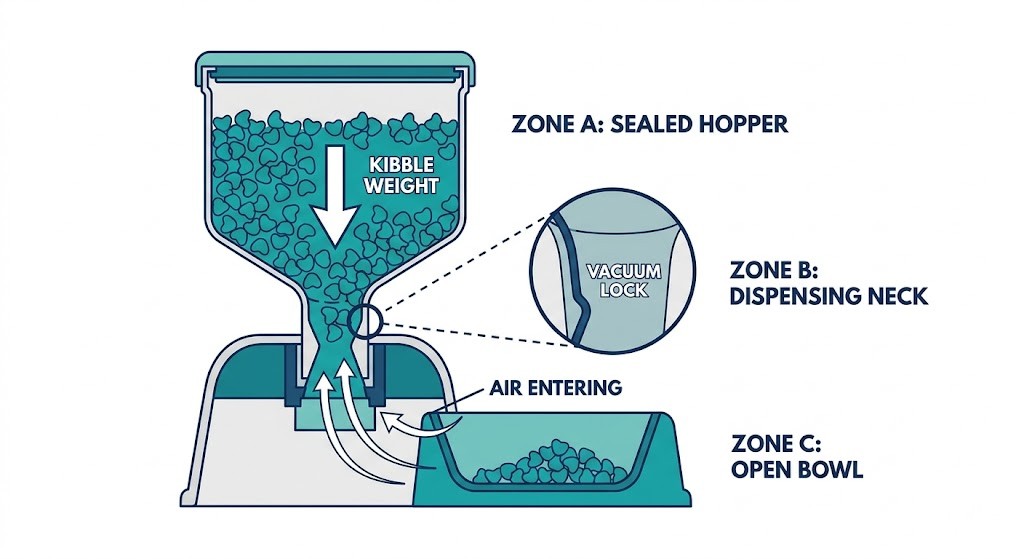
Gravity pet feeders work by using the weight of kibble and air pressure to refill your pet’s bowl automatically as they eat. A vacuum lock at the dispensing neck stops food from flooding out all at once. They’re affordable, reliable, and require zero power, but they offer no portion control. Only suited to healthy-weight pets that naturally self-regulate their food intake.
Your cat’s bowl refills itself while you’re at the office. No batteries. No WiFi. No app to crash at 2 am. Just physics.
Gravity feeders have been around for decades, and millions of pet owners use them every day without really thinking about what’s happening inside that plastic tower. Which is fine, until the food stops flowing, your cat starts howling, and you’re Googling “why is my gravity feeder not working” at 7 am.
Here’s the thing: most explanations stop at “food falls when the bowl has space.” Technically true. But it misses the actual mechanics: the air pressure, the vacuum lock at the neck, the kibble geometry that determines whether your feeder flows smoothly or jams solid every three days.
This guide covers all of it. The physics, the failure points, and most importantly, whether a gravity feeder is actually the right choice for your pet.
What Is a Gravity Pet Feeder?
A gravity pet feeder is a two-part device. A sealed food reservoir sits above an open bowl, connected by a narrow dispensing neck. As your pet eats and the bowl empties, more food drops down automatically with no electricity, no programming, and no moving parts.
That simplicity is the whole appeal. No batteries to die, no app to crash, no motor to jam. Gravity feeders sit at the budget end of the feeder market, typically $20 to $45, and they’re widely available in pet stores and online. They come in sizes ranging from a 5-cup single-cat model up to 18-pound capacity versions designed for large dogs or extended trips away from home.
Three broad types exist: dry-food-only gravity feeders (the most common), gravity water dispensers (same physics, different reservoir), and combo units that bundle both side by side. For this guide, we’re focused on food feeders.
How Does a Gravity Pet Feeder Actually Work?
Food flows from the reservoir into the bowl as the pet eats, driven by the weight of the kibble above and regulated by an air-pressure equilibrium at the dispensing neck.
Here’s the plain-English version. Your pet eats. The bowl level drops. A small air gap opens at the base of the neck. Air enters the reservoir. The partial vacuum inside releases. Gravity pulls a trickle of kibble down to refill the bowl. Once the bowl reaches the “fill line” set by the neck’s geometry, the flow stops again. Then your pet eats more, and the cycle repeats.
That’s the whole mechanism. No electronics. It’s the same principle as an inverted water cooler bottle, which also uses atmospheric pressure and gravity to refill steadily without flooding. Pretty clever for something under $30.
The Actual Physics Behind Gravity Feeders
Why Food Doesn’t Flood Out All at Once
A narrow dispensing neck creates a partial vacuum lock that holds kibble in place until the bowl empties enough to let air in and break the seal.
Think of it this way. When the bowl is full, kibble at the base of the neck is essentially plugging the hole. No air gap means no incoming air. Without incoming air, atmospheric pressure outside can’t equalize the pressure inside the sealed hopper, and without that equalization, gravity can’t pull more food down. The hopper holds its contents like an inverted bottle pressed tight against a flat surface.
The moment your pet eats enough to drop the bowl level below the neck’s lip, air sneaks in around the edge of the kibble pile. Pressure equalizes. A small release of food drops down. The bowl refills just enough to cover the opening again. Equilibrium restored.
This is the “vacuum lock” effect, and it’s why a properly designed gravity feeder doesn’t avalanche a full hopper of food onto the floor the second you set it up.
How the Dispensing Neck Controls Flow Rate
The shape of the neck (its diameter, the chute angle, and where the lip sits relative to the bowl) determines how much food drops per release cycle.
A wider neck means bigger bursts. Narrower means smaller trickles. The “bowl-fill line” is the height at which kibble covers the neck opening and stops the airflow. This varies by design. Some feeders are tuned for very shallow bowl fills, which is great for cats that graze slowly.
Others allow deeper fills that suit larger dogs who empty the bowl each meal. That mismatch is why a feeder designed for a cat can look perpetually overfull when used with a fast-eating terrier.
Step-by-Step: The Refill Cycle
Here’s what’s actually happening during a single feeding:
- Pet eats: kibble level in the bowl drops
- Air gap opens: a small gap forms between the bowl surface and the neck opening
- Air enters: atmospheric air enters the neck and travels up into the sealed reservoir
- Vacuum releases: pressure inside the hopper equalizes with the outside
- Kibble drops: gravity pulls a small amount of food down into the bowl
- Bowl refills to lip level: kibble covers the neck opening again, resealing the airflow
- Cycle pauses: until the pet eats again
Five to ten seconds from empty to refilled, silently, indefinitely. Elegant for a piece of plastic with zero moving parts.
Food Compatibility and Jamming Explained
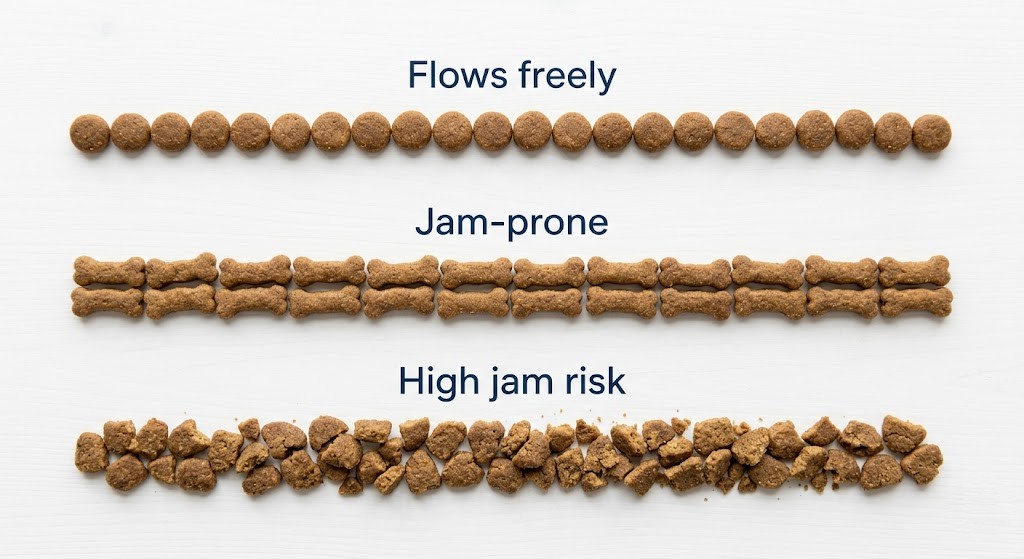
Round, dry kibble between 8 and 12mm flows most reliably; elongated, high-fat, or humidity-softened kibble causes the majority of gravity feeder jams.
Most guides just say “works with dry kibble only.” True, but incomplete. Here’s what actually causes jams and why:
Kibble shape matters more than most people realize. Round or slightly oval kibble rolls freely through a curved chute. Elongated kibble (bone-shaped pieces, irregular sizes, angular treats) can bridge across the dispensing neck and create a physical plug. That plug behaves exactly like the vacuum lock: once it seals the opening, no air can enter, and the whole system stalls.
High-fat coatings are a hidden culprit. Premium kibble with heavy fat coatings or fish oil sprays gets tacky over time, especially in warm rooms. Sticky kibble clumps in the reservoir and won’t free-fall cleanly. If your feeder was working fine and then started jamming after a food switch, fat content is the first thing to check.
Humidity swells kibble. Store bulk food in an airtight container, not in the gravity feeder itself. Kibble left in an open bag or loaded into the hopper in a humid room absorbs moisture, swells slightly, and loses its clean round shape. According to our automatic feeder troubleshooting guide, keeping the hopper at about 75% full (rather than packed to the brim) also reduces pressure on the neck and cuts jam frequency significantly.
Quick watch-out list: oily kibble with a visible fat sheen, soft training treats, mixed kibble sizes in the same hopper, and any pieces larger than the neck diameter.
Gravity Feeder vs Automatic Feeder: When to Use Which
Gravity feeders suit self-regulating grazers needing continuous food access; automatic feeders suit pets needing scheduled meals, precise portions, or weight management.
| Criteria | Gravity Feeder | Automatic Feeder |
|---|---|---|
| Portion control | None (free access) | Yes (programmable) |
| Power needed | Zero | Batteries or AC |
| Jam risk | Low (round dry kibble) | Low to medium |
| Obesity-prone pets | Not suitable | Suitable |
| Multi-pet households | Risky | Better option |
| Price range | $20 to $45 | $45 to $200+ |
The honest answer: gravity feeders win on simplicity, cost, and outage-proof reliability. Automatic feeders win on everything health-related. If your pet self-regulates and holds a healthy weight, a gravity feeder is a solid, no-fuss choice. If they’d eat until the bag was empty given half a chance (and plenty of cats and dogs absolutely would), scheduled portions are the safer route.
For a full breakdown by pet type and lifestyle, see our automatic vs manual feeder comparison.
Which Pets Are Gravity Feeders Best (and Worst) For?
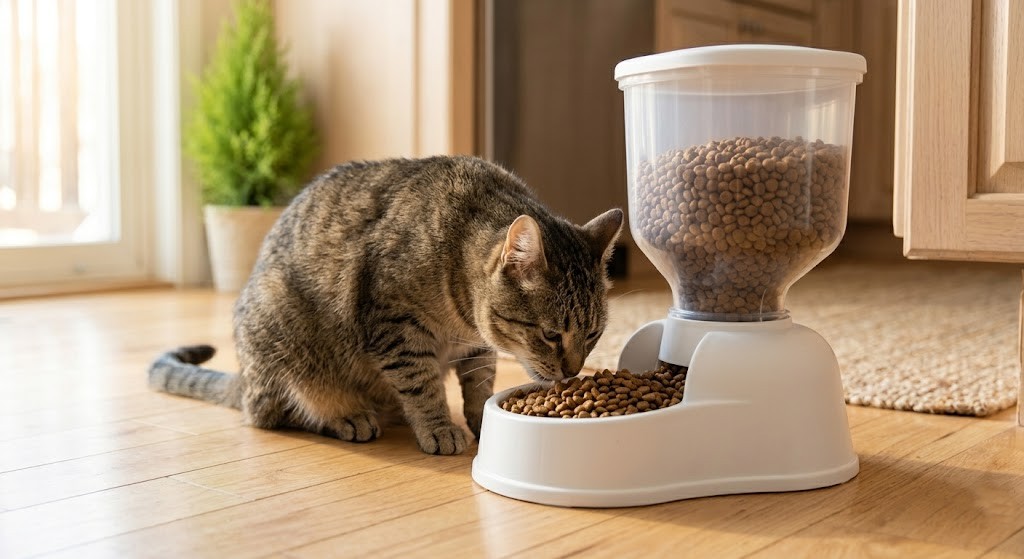
Gravity feeders suit healthy-weight pets that naturally self-regulate; they’re a poor match for obese, food-motivated, or medically managed animals.
Good candidates:
- Self-regulating adult cats that graze throughout the day without overeating
- Calm multi-cat households where all cats eat at a similar pace and food competition isn’t an issue
- Healthy-weight small dogs that respond normally to fullness cues
We tested the Aspen Pet Lebistro Gravity Feeder for 120 days with two cats: a 9 lb tabby and an 11 lb domestic shorthair, both confirmed self-regulators. Zero flow issues. Zero jams across three different kibble brands.
The feeder ran without a single problem. That said, both cats gained around 1 lb each over those four months. Not dramatic. But it’s a real reminder that “self-regulating” is something you confirm over time, not something you assume.
Risky candidates (and this part matters):
- Obesity-prone dogs. Most dogs are not self-regulators. A Labrador, Beagle, or Dachshund will eat whatever’s available, without exception. A gravity feeder with a full hopper is an all-you-can-eat buffet with no closing time.
- Diabetic cats on insulin. These cats need meals timed precisely around injections. Free-feeding makes it medically impossible to manage safely. Your vet will almost certainly recommend a timed feeder instead.
- Multi-pet households with food competition. One dominant pet can park in front of the gravity feeder and eat everything while a timid housemate goes hungry. Gravity feeders have no mechanism to prevent this.
If your pet fits any of those risky categories, our guide on preventing cat overeating with automatic feeders covers better-suited alternatives.
(Always consult your veterinarian before making changes to your pet’s diet or feeding schedule.)
What to Look for When Buying a Gravity Feeder
Short and practical:
- Capacity: Match it to your absence length. Two adult cats eat roughly 1.5 to 2 cups daily combined. An 18 lb reservoir holds approximately 72 cups, far more than a long weekend requires.
- Neck opening width: Check it against your kibble size before buying. Most manufacturers specify a compatible kibble range in the product details.
- Material: BPA-free plastic is the minimum. Avoid PVC. Stainless steel bowls are easier to clean and don’t retain food odors the way plastic does.
- Base stability: Wide bases resist tipping. If you have a food-motivated dog who might body-check the feeder mid-meal, stability matters a lot.
- Cleaning access: The reservoir must be fully removable. If you can’t get a brush into every corner, bacteria build up fast, especially in warmer climates.
Our gravity feeder buying guide covers the top-rated models across price points, with our full test data included.
Frequently Asked Questions
Why doesn’t a gravity feeder overflow?
The dispensing neck creates a vacuum lock. Once kibble covers the neck opening, air can’t enter the reservoir, so the pressure balance stops more food from falling into the bowl.
Can gravity feeders cause overeating in cats or dogs?
Yes, particularly in food-motivated breeds. Gravity feeders provide unlimited food access with zero portion control. Pets that don’t naturally self-regulate will consistently overeat. Consult your vet if weight is a concern.
Are gravity feeders better than automatic feeders?
Neither is universally better. Gravity feeders win on cost, simplicity, and reliability. Automatic feeders win on portion control, feeding schedules, and suitability for weight management or medical diets.
What kind of food can you use in a gravity feeder?
Dry kibble only, ideally round or slightly oval pieces between 8 and 12mm. Wet food, semi-moist food, and irregularly shaped treats will spoil, clump, or jam the dispensing neck.
Do gravity feeders work with wet food?
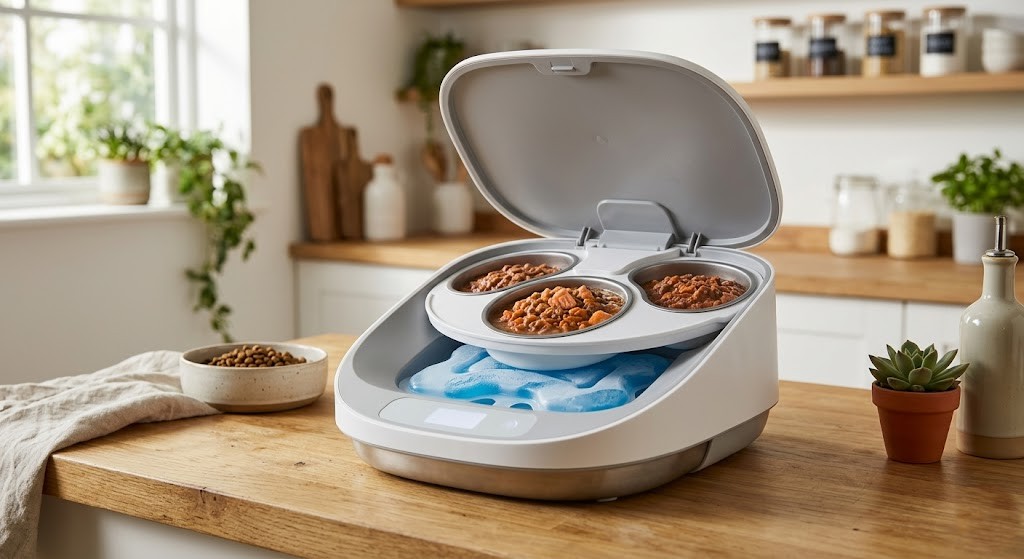
No. Wet food exposed to open air spoils quickly and will clog the dispensing mechanism within hours. For scheduled wet food feeding, a timed feeder with sealed individual compartments (like the Cat Mate C500) is the correct tool.
Can gravity feeders be used for multiple pets?
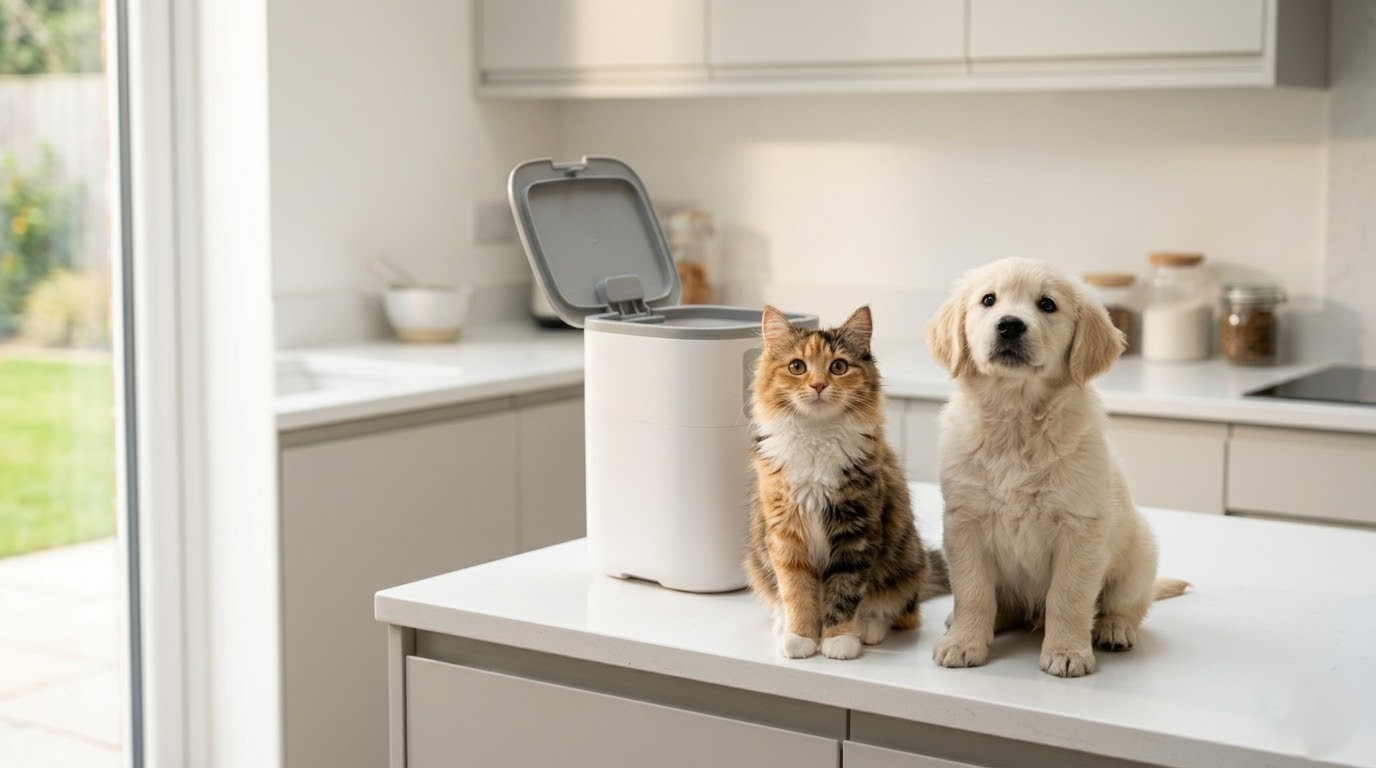
With caveats. If your pets eat peacefully at a similar pace with no food competition, yes, gravity feeders work fine in multi-pet homes. If one pet dominates food access or they eat at very different speeds, a gravity feeder will consistently underfeed the more timid animal.
Conclusion
Gravity feeders are about as close to zero-maintenance as pet feeding gets. The physics is genuinely elegant: a vacuum lock, an air-pressure equilibrium, a dispensing neck that meters flow without a single electronic component. Hard to argue with the right pet.
The right pet is the key phrase. If your cat grazes calmly throughout the day and holds a healthy weight, a gravity feeder is a reliable, affordable setup that’ll likely outlast most smart feeders on the market. If your dog would empty an 18 lb hopper in 48 hours, given the chance (and you know who you are), scheduled portions are the smarter call.

Leave a Reply